Two full sleeves, one black and one red. The persona arm ends in tears. The shadow arm ends in a blank. Each one is holding what the other is supposed to be.
Both my arms are sleeved past the wrists and down the fingers. One runs black, heavy filigree and doll-figures, going solid through the hand and down the fingers. The other is flooded with red: blackletter script, a jackalope, flowers, a cartoon Venus flytrap, zombies. On the back of the black hand there is a square with two crossed-out eyes and a line where a mouth should be. On the back of the red hand there is a woman’s face with red running from both eyes and both hands raised over the mouth.
I read them the plain way. The colour arm is the persona and the black arm is the shadow. The masks I have had to wear are on one side, and most of them were not optional. I know what has lived in it. I have a long history with anxiety and depression and no interest in pretending otherwise.
Neither arm keeps to its brief. There is orange and teal and green scattered through the black. There is solid black running through the red. The tidy version was never on the body.
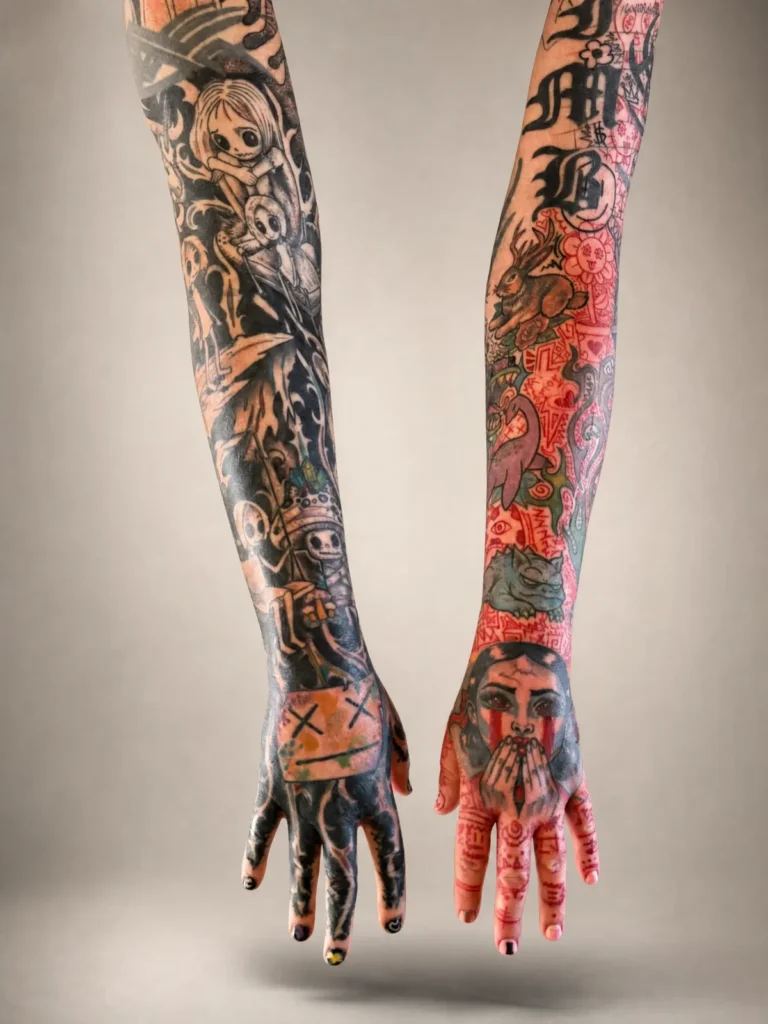
Which side is which turns out to matter, and not in the direction anyone would guess. The persona is on my left. The shadow is on my right.
Sinister is the Latin word for left. It collected the rest on the way into English: unlucky first, and eventually malign. Dexter is the Latin for right, and it gave us dexterity. The same split runs through half of Europe. The French for law is droit, which is also their word for right. German Recht covers right, law and justice at once. Two thousand years of filing, and it lands in the same place every time. The right hand is the correct one and the skilled one. The left is where the dark material gets kept.
Mine are the wrong way round. The lawful side carries the shadow. The sinister side carries the mask I was rewarded for wearing.
Then look at where they sit. The cancelled one is on the black hand. The weeping one is on the red. Each arm ends carrying the other one’s face.
The shadow is not the dark half
The word underneath all this is older than psychology. Persona was the mask a Roman actor spoke through, and our word person comes straight out of it. To say “the person and the shadow” is already to say “the mask and the shadow” without meaning to.
Jung’s persona is not a lie people tell. He described it as a settlement, a compromise between what somebody is and what the world around them requires them to appear to be. Everyone runs one. The trouble is not having a persona. It is forgetting you are wearing it, at which point the settlement starts making decisions on your behalf.
The shadow is the leftover from that settlement. Jung was clear that it is not the evil half, and he kept insisting it holds value as well as what got disowned. What lands there depends on the terms of the deal. Where composure was demanded, grief becomes shadow. Where the deal required a man to be capable, so does need.
So the placement is right. A blank bag-face is not shadow material. That is the mask itself, drawn honestly, a face with nobody behind it, presented to the world by a hand that reaches out. The weeping face on the colour arm is the opposite case. That is what the settlement excluded, painted in the brightest ink on the body.
Winnicott sharpens it. His false self forms early and forms compliantly, and its job is protective. It exists so that whatever is unfinished underneath does not get found before it can survive being found. Not the antagonist of the story. Closer to a nurse. Winnicott also left behind the strange formulation that it is a joy to be hidden and a disaster not to be found, which is roughly what a full sleeve does to a body. Maximum visibility. Minimum legibility. Everybody looks. Nobody can read it.
The shadow ended up on my dominant hand
Hands are the one surface that cannot be covered. Sleeves come down over everything else.
The blackwork on the shadow arm does not stop at the wrist. It runs out through the hand and down the fingers, solid, and stops just short of the ends.
The last of the black is not ink. I paint those nails, and the ones on the other hand white, and repaint both when they chip.
I read that terminal black through a line usually credited to Jung: no tree, it is said, can grow to heaven unless its roots reach down to hell. It is his, and where it sits changes it. The line appears in Aion, inside an argument about Christ and Satan as counterpoles of a single tension, not as advice about hard times. Jung’s own hedge, “it is said”, has him passing on an older saying rather than minting one. The same figure runs through Nietzsche’s tree in Zarathustra, where the harder a tree strains towards the light, the harder its roots drive down into what is bad.
Roots run to the extremities. The blackwork terminates at the furthest point from the heart, on the part of the body that does the reaching. If the arm is the trunk, the fingers are the root tips.
And the very end of it comes off. The ink holds to the last knuckle and then the black is varnish, reapplied by hand every few days. So the scheme runs the whole length of both arms and out to the ends, black on one side and white on the other, and the furthest point of the shadow is the one part I have to keep choosing.
Then there are the stickers. Cartoon dinosaurs, mostly, on both hands, over the black and over the white. I have no reading for those.
And it is my dominant hand. That is the hand that signs and pays and goes out first in a handshake. Whatever gets done in my life gets done by the black hand, which puts the shadow at the working end of the body rather than off to one side as something to be managed in private. The lawful side, the dexter side, the side the language reserves for skill and correctness, is the side I blacked out. Not because the dark material sits apart from the work. Because it has been doing the work the whole time.
The thinkers are inked on that arm for the same reason. Jung, Heidegger and Nietzsche sit on the shadow side not because philosophy is gloomy but because they turned a condition into a question. Depression on its own is weather. Read alongside people who took the dark end of experience as information rather than malfunction, it becomes something with a structure, and a structure can be worked with.
Which is why the cancelled face belongs where it is. It is a more accurate depiction of the condition than any weeping face could manage, and anyone who has been inside it knows why. Depression does not present as grief. It presents as an absence of signal, a face that has stopped transmitting, and from the outside it reads as fine.
Made things on one arm, testimony on the other
Lacan described the structure before anybody put it on a limb. In the mirror stage an infant with no motor coordination, experiencing its own body as uncoordinated and in pieces, sees a whole shape in the mirror and takes it for itself. The ego forms as an image. Lacan’s word for the shape that image takes is armour, an alienating identity assumed by a body that does not yet cohere, and he set it against what he called the fragmented body, which surfaces in pictures of dismembered limbs and disjointed figures. He pointed at Bosch for the catalogue.
Look at the dark arm. Doll-figures with blank eyes and stitched mouths, one of them holding a smaller one wearing the same face. Figures half-swallowed by the black around them. These are not pictures of people. They are pictures of made things in a person’s shape, which is a fragmented body of a different order to Bosch’s, laid down as a continuous skin. Both halves of the structure are on the same forearm, the picture of coming apart, worn as armour.
And the cancelled face is not one image at the end of the arm. It is what most of that arm is already wearing.
The colour arm runs in two families. Zombies first, several of them, and not the horror version. A zombie is what conformity produces. A body running a script so that other people can read it, coherent and predictable and costing whoever is inside it everything. An NPC. That is what the masks were for.
Then the cryptids, a jackalope and a Loch Ness monster among them. Those two went on in the same run, so that category was chosen rather than noticed afterwards.
A cryptid is not a thing that fails to exist. It is a thing everybody can describe and nobody can produce. The reports agree with each other and the detail is elaborate, and there has never been a specimen. People are certain they have seen one.
Which puts made things in a person’s shape on one arm, and on the other, figures that exist on testimony alone.
And it sits oddly against what these arms now do. Being legible is what the zombie cost. The sleeves make me unreadable at a glance.
And the composition is not a record laid down once. There has been work on these arms for twenty years, and what went on first was tribal. Early 2000s, black bands and points, and a dragon. The version of transgression that had already been approved and was being worn by half the men my age. Safe. Chosen by somebody still checking what would be acceptable, and I could not have told you that was what I was doing at the time.
The opinion I held at the time is the part that still stops me. Tattoos, I would have told you, were a socially acceptable form of self-mutilation. I was saying that with tribal on both arms.
The covering did not start recently either. There is a cartoon Venus flytrap on the colour arm sitting where the dragon used to be. A plant that eats things, put over the safest monster available in 2003.
Most of it is now under a blastover put down in the last few months. The tribal is still there, covered, still deciding what can go over it, because a blastover works with the density that already exists rather than starting clean. Nothing legible. Nothing gone either.
None of which arrived steadily. I get blasted. Long stretches of nothing and then a great deal of skin covered in a short run, so the arms did not accrete year by year, they went on in campaigns. The arrangement still runs forwards and only reads backwards. Parts of it were planned. The shape of the whole thing got planned in retrospect, including here.
Which makes the covering the event, rather than the imagery on top of it. What got buried was the compliance. I do not have the disease of normality in my veins any more, and what has been sitting in me is welcome to come up through the skin.
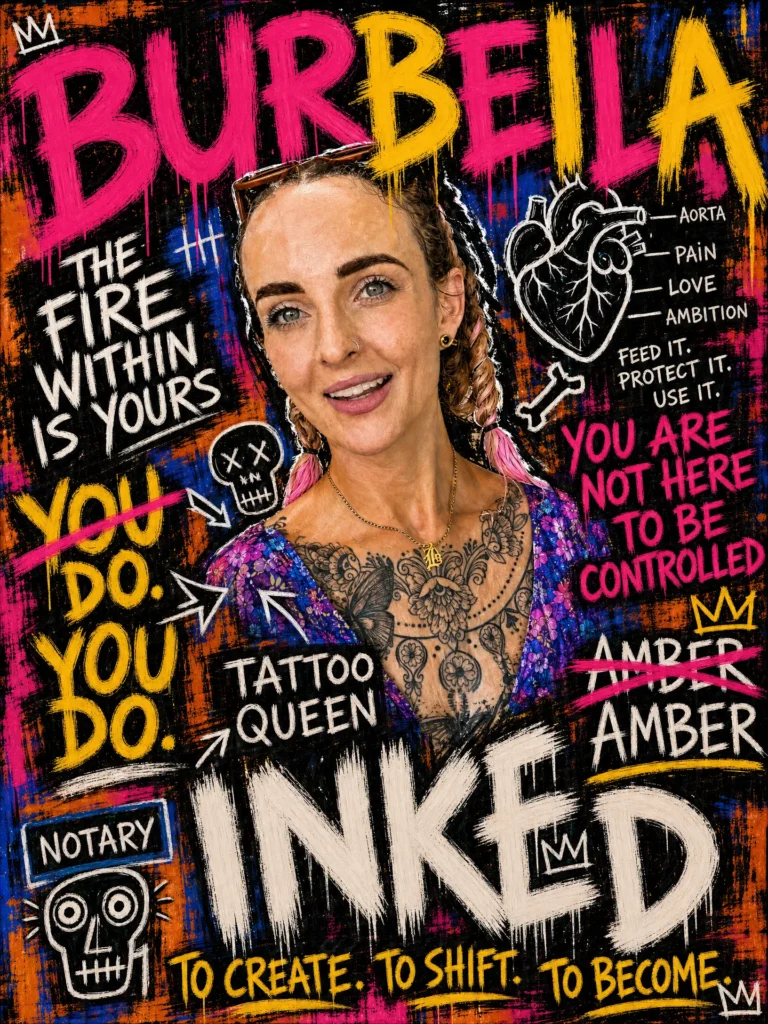
None of which I did. The arms are Amber Bastin’s work, out of a private studio in Havelock North. Her training runs the unusual way round: fine art first, a Bachelor of Fine Arts out of Wellington in 2010, then tattooing self-taught from 2012, then her own studio from 2021. Fine art teaches composition and weight, where the eye goes and what has to be given up for it to go there. The trade teaches the part an art school cannot. How to build on a surface with no undo. How to place a design on a limb that changes shape every time it moves. What ink does over decades as it spreads. How skin heals, which is the part nobody fully controls and every tattooist has to design around anyway.
Going over old work is a different problem from a blank arm and it is not one solved by wanting something. Skin responds differently person to person and there is no way to know how yours will behave without having done it for a long time. Some of what was on me was black and got colour added and came back. Some had faded and bled and had to be covered instead. Those are two opposite decisions about ink that both look like old tattoos from where I am standing.
Nothing here was ever a matter of somebody overriding me. It has been co-created the whole way through, which includes the conversations, and those have gone a long way past what goes where. Persona and shadow got talked about in that room while persona and shadow were being drawn.
Why a tattoo is permanent when skin is not
In 2018, a group led by Anna Barańska published work in the Journal of Experimental Medicine on why tattoos persist. Using a mouse model that let them selectively kill off dermal macrophages, they showed that the pigment is held by those cells alone, and that when the cells carrying it are destroyed, the released particles are captured again by the macrophages that replace them. Capture, release, recapture, with no visible fading. Persistence does not depend on any cell lasting. It depends on renewal.
Human imaging has since found the pigment sitting inside macrophages, mast cells and fibroblasts, and still detectable in the constantly-replaced cells of the epidermis in tattoos nine years old. The same work found collagen in tattooed skin running in a more directional arrangement than untattooed skin, closer in structure to scar tissue, measurably firmer and less elastic.
So the image is permanent and nothing holding it is. Every cell carrying a fragment of that composition will die, and each one will hand its pigment to whatever arrives next. The arms are not a record that was made once and then kept. They are a record being re-made continuously, cell by cell, by a body that never agreed to remember anything and cannot stop.
That much is settled. The rest is not. Whether what is being relayed is a settlement, a defence, or an accurate description of a person is not something the skin has an opinion about, and on the available evidence, neither does the body doing the relaying.
FAQ
Is the shadow the dark half of a person?
No. Jung described the persona as a settlement between what somebody is and what the world requires them to appear to be, and the shadow as the leftover from that settlement. What lands there depends on the terms of the deal. Where composure was demanded, grief becomes shadow. Where the deal required a man to be capable, so does need.
What does sinister mean in Latin?
Sinister is simply the Latin word for left. It acquired unlucky and then malign on the way into English. Dexter is the Latin for right and gave us dexterity. The same split runs through French droit and German Recht, which cover right, law and justice together.
Why are tattoos permanent if skin cells are replaced?
Because the pigment is relayed rather than kept. Barańska and colleagues showed in 2018 that tattoo ink is held by dermal macrophages, and that when those cells die the released particles are captured again by the macrophages replacing them. Persistence does not depend on any cell lasting. It depends on renewal.
Did Jung write that no tree can grow to heaven unless its roots reach down to hell?
Yes. It appears in Aion, inside an argument about Christ and Satan as counterpoles of a single tension rather than as advice about hard times. Jung’s own hedge, “it is said”, has him passing on an older saying rather than minting one.
The arms are the work of Amber Bastin at Burbeila Inked, Havelock North, over more sessions than either of us has counted. Nothing on them was designed alone.
Related: The Collective Shadow · The Performance of Authenticity · The Physiological and Neurological Impact of Conformity
If this is the kind of thinking that doesn't leave when the tab closes.
Subscribe