Twenty years of building an arm inside a tradition I could not have identified. It came up in conversation with my tattooist. She said have you heard of this guy.
The red arm is crowded. Blackletter script at the top, a jackalope, flowers, a cartoon Venus flytrap, zombies, dense red marks running under and around all of it so that nothing is what the eye is meant to land on. Text used as image rather than as caption.
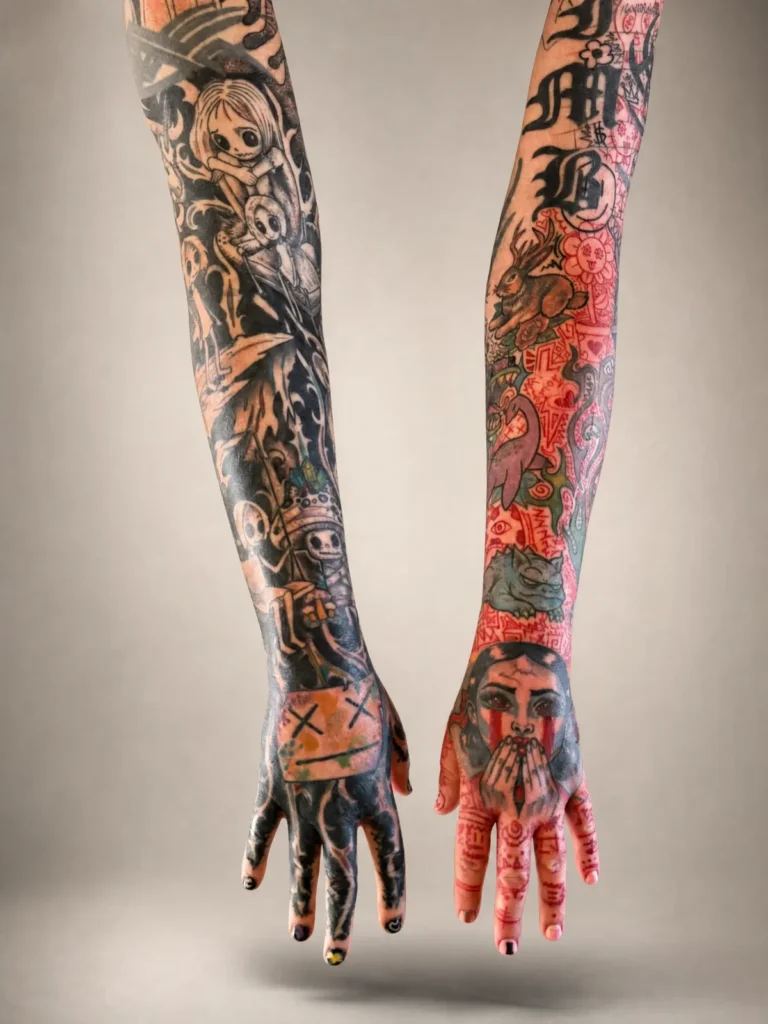
I chose all of it and I could not have told you what it was.
The individual pieces I could account for. What I had no word for was the manner of the thing: the crowding, the way the marks between the figures carry as much weight as the figures, the absence of any single point organising the rest. I knew what I wanted and I knew when a design was wrong, and I had no idea that what I was reaching for had a name, a decade, a set of arguments and a critic who set out to demolish it in 1981.
Amber told me, and not as a lesson. We were talking about art, which is what we talk about, because she is artsy and the stuff I am drawn to is artsy. She said have you heard of this guy.
The guy was Basquiat. The movement, which arrived after him in the conversation and after him in my understanding, was neo-expressionism.
What neo-expressionism actually was
Neo-expressionism was the return, through the late 1970s and across the 1980s, to figuration, myth, personal symbol systems and rough handling, set against the cool restraint of the minimalism and conceptualism that came before it. Basquiat, Baselitz, Kiefer, Clemente, Schnabel, Kippenberger, Lüpertz, Immendorff.
Its arrival has a date and an address. On 15 January 1981 the Royal Academy in London opened A New Spirit in Painting, curated by Norman Rosenthal, Christos Joachimides and Nicholas Serota. Thirty-eight painters. Big canvases, the hand of the artist back in view, figuration reasserted after a decade in which the serious position had been to do without it.
None of which I knew while picking imagery for a forearm in Hawke’s Bay.
The style was never neutral
The label now describes a surface. Thick handling, rough figures, loud colour. It began as an argument about history, and the argument is still stuck to the vocabulary.
In West Germany the return to the figure forced a confrontation the country had organised itself around avoiding. For two decades after the war, abstraction had been the safe option, a manner with no content to answer for. Putting the figure back meant putting the national imagery back with it.
Anselm Kiefer did it first as a student. In 1969 he travelled through Switzerland, France and Italy photographing himself performing the Nazi salute, and showed the results at his degree show in Karlsruhe under the title Heroic Symbols. They stayed largely unseen for six years, until he published a sequence of them in a Cologne art journal in 1975 as Occupations. Georg Baselitz began inverting his figures the same year, 1969, and kept doing it for the rest of his life. He died this April, aged 88.
Inverting a painting gets described as a formal device. It also works as a refusal. An upside-down figure cannot be comfortably consumed as subject matter, which means the politics are not in the message. They are in making the picture awkward to use.
New York was arguing about something else: who gets depicted, and who gets paid. Jean-Michel Basquiat came out of SAMO tags into a gallery system with almost no Black painters in it, and put crowns on Black boxers and jazz musicians and street figures, while covering the same canvases in dollar signs, copyright marks and the language of ownership. The crown is a claim about value, made by somebody whose own market price was being set in rooms he had spent most of his life locked out of.
That is the inheritance attached to dense scrawl over dense scrawl, figures competing for room, and no single thing to land on. It is the shorthand of people arguing about who counts.

Which is a heavier inheritance than I signed up for on the other arm too, where the black went on over everything I had chosen when I was still checking what was acceptable.
A sleeve is built the way the picture plane is built
The deeper correspondence is not in the imagery. It is in the method.
A sleeve is not composed and then executed. It also does not accrete gently. I get blasted, which means long stretches of nothing and then a great deal of skin covered in a short run, so the arms went on in campaigns rather than in instalments. Most of what is there now arrived in the last few months, over twenty years of earlier work, and the new imagery had to take account of what was already dense and what was already dark.
That is closer to how those paintings got made than slow accretion would be. Big, fast, physical, decided largely in the doing, with the previous decision still wet underneath.
It is also how the neo-expressionist picture plane behaves. Crowded, non-hierarchical, no vanishing point organising the rest, meaning produced by adjacency rather than by sequence. Things sit next to each other because that is where there was room.
The marks between the images are not filler either. In Basquiat the scrawl carries as much as the figure, and the density is the point rather than the background to it. Strip the connective marks out of an arm and what is left is a sticker album, a set of unrelated objects parked on the same limb. The scribbles are the argument that all of it belongs to one person. They are the only part of the composition saying these things happened to the same body in the same order.
Basquiat’s defence of crossing out his own words ran the same way. Obscuring them, he said, is what makes people want to read them, so the deletion draws the eye rather than repelling it. There is a version of that on my other arm, where whole figures are half-swallowed by black and the swallowing is what you look at.
The difference is that a painter can stop. The canvas gets sold, hung, insured and left alone. An arm keeps going as long as its owner does.
The objection that lands
In the autumn of 1980 the art historian Benjamin Buchloh wrote an attack on the whole return, published the following spring in October under the title “Figures of Authority, Ciphers of Regression.” His charge was that this was regression dressed as renewal. Expressive rawness manufactured as a saleable style. Authenticity produced to order for a market that wanted paintings again. He read the Royal Academy show as a reaffirmation of rigid conservatism.
Whatever that is worth as art history, it transfers onto tattooing without needing adjustment. Transgression became an industry. The full sleeve is a uniform now, recognisable at forty paces, and the type it identifies is well documented. I know exactly what these arms file me as. I knew before the first session and every year since has made the type more legible rather than less, which is its own joke given what the ink was supposed to be for.
The charge has a limit, and the limit is narrow. Buchloh was writing about a market in objects. A tattoo cannot be sold, resold, hung, insured, stored or inherited. It has no secondary market and no buyer. It is the one form of image-making where the work and the collector are the same organism, and it is scheduled for destruction.
That does not answer the objection. It just means the money went somewhere else.
Thirty-eight painters, none of them women
Here is the part that should be said plainly, because it is the movement’s own record and not a later reading of it.
Every one of the thirty-eight painters in the Royal Academy show was a man. The curators addressed the omissions in the catalogue and called them justified, on the grounds that the exhibition already suggested a great many possibilities. Maria Lassnig was added when Rosenthal restaged the show in 2018, thirty-seven years later.
So a movement that was arguing, loudly and in public, about who gets depicted and who gets counted and whose work gets valued, held its defining exhibition and did not count women at all.
It would be comfortable to file that as a period problem. The research does not allow it.
Diana Miller’s review of gender in artistic careers names three mechanisms, and the first one is that collective ideas about creative genius are built on a masculine subject. The second is that aesthetic evaluation is biased toward men. The third is that art careers run on self-promotion, which is read differently depending on who is doing it. That is not a metaphor for the Royal Academy exhibition. It is a description of the machinery that produced it.
The tattoo-specific work says the same thing in a smaller room. Emma Beckett interviewed fifteen women artists across the US, the UK and Australia and found them caught in a double bind: too feminine for the industry and needing to be feminine enough to do the emotional labour the job also demands. A study of twenty tattooed people found that women and gender-nonconforming participants reported discomfort, intimidation and sexual harassment in male-dominated tattoo spaces, and that no cisgender men reported anything of the kind. Fifteen Brazilian artists described the same stigma running through their professional identity.
These are small qualitative studies, mostly theses, with sample sizes in the single and low double figures. They cannot tell you how common anything is. What they can tell you is that the pattern shows up in every country anybody has looked, and that Miller’s review of the wider art world, which is not a small study, describes the mechanism that would produce it.
So the vocabulary reached me through a woman with a fine art degree, working in a trade, out of a private studio in a small town at the other end of the world, applying a movement’s language to a surface it never worked on and the one place its output cannot be resold. She works across everything, fine line through to blackwork, and the arms are one register out of several she has.
I do not know what any of that has cost her, or whether she would describe it as costing anything. The literature is about a pattern and she is a person, and I have never asked.
What having the word changed
Nothing on the arm. The imagery was chosen before the name existed for me and the name has not moved a single mark.
For twenty years I was drawn to a manner of picture-making I could not describe, and I assumed the pull was personal taste, which is the most private explanation available and the least accurate one. It turns out I had been reaching for a set of decisions somebody else made about how a picture should behave, worked out in Cologne and Karlsruhe and Lower Manhattan before I could read, and carried to me by a tradesperson who studied it.
There is a version of this where finding the name is a small loss. The taste turns out to be inherited, the instinct turns out to be a tradition, and the arm you thought you were composing was being composed through you.
There is another version where the name is the useful thing, because a tradition can be argued with and a preference cannot.
I have not settled which one it is. I have the arm either way, and the arm is not asking.
FAQ
What is neo-expressionism?
The return, through the late 1970s and across the 1980s, to figuration, myth, personal symbol systems and rough handling, set against the minimalism and conceptualism that came before it. Its public arrival is usually dated to A New Spirit in Painting at the Royal Academy in London, which opened on 15 January 1981 and showed thirty-eight painters.
Why is Basquiat’s crown significant?
He put crowns on Black boxers, jazz musicians and street figures while covering the same canvases in dollar signs, copyright marks and the language of ownership. The crown is a claim about value, made by somebody whose own market price was being set in rooms he had spent most of his life locked out of.
What was Buchloh’s criticism of neo-expressionism?
Benjamin Buchloh argued it was regression dressed as renewal: expressive rawness manufactured as a saleable style, authenticity produced to order for a market that wanted paintings again. The essay is “Figures of Authority, Ciphers of Regression,” written in autumn 1980 and published in October 16 in spring 1981.
Were there women in the neo-expressionism movement?
Not in its defining exhibition. All thirty-eight painters at the Royal Academy in 1981 were men, and the curators addressed the omissions in the catalogue and called them justified. Maria Lassnig was added when Norman Rosenthal restaged the show in 2018. Research on gender in artistic careers describes the mechanism: ideas of creative genius built on a masculine subject, biased aesthetic evaluation, and careers requiring self-promotion that is read differently depending on who does it.
The arms are the work of Amber Bastin at Burbeila Inked, Havelock North.
Related: My Arms Are the Wrong Way Round · The Performance of Authenticity · The Physiological and Neurological Impact of Conformity
If this is the kind of thinking that doesn't leave when the tab closes.
Subscribe