The Lie That Gets You Out of Bed
Ernest Becker said the self is a defence built against death. Then he had to die and the science built on his book is still fighting about what he meant.
Ernest Becker said the self is a defence built against death. Then he had to die and the science built on his book is still fighting about what he meant.
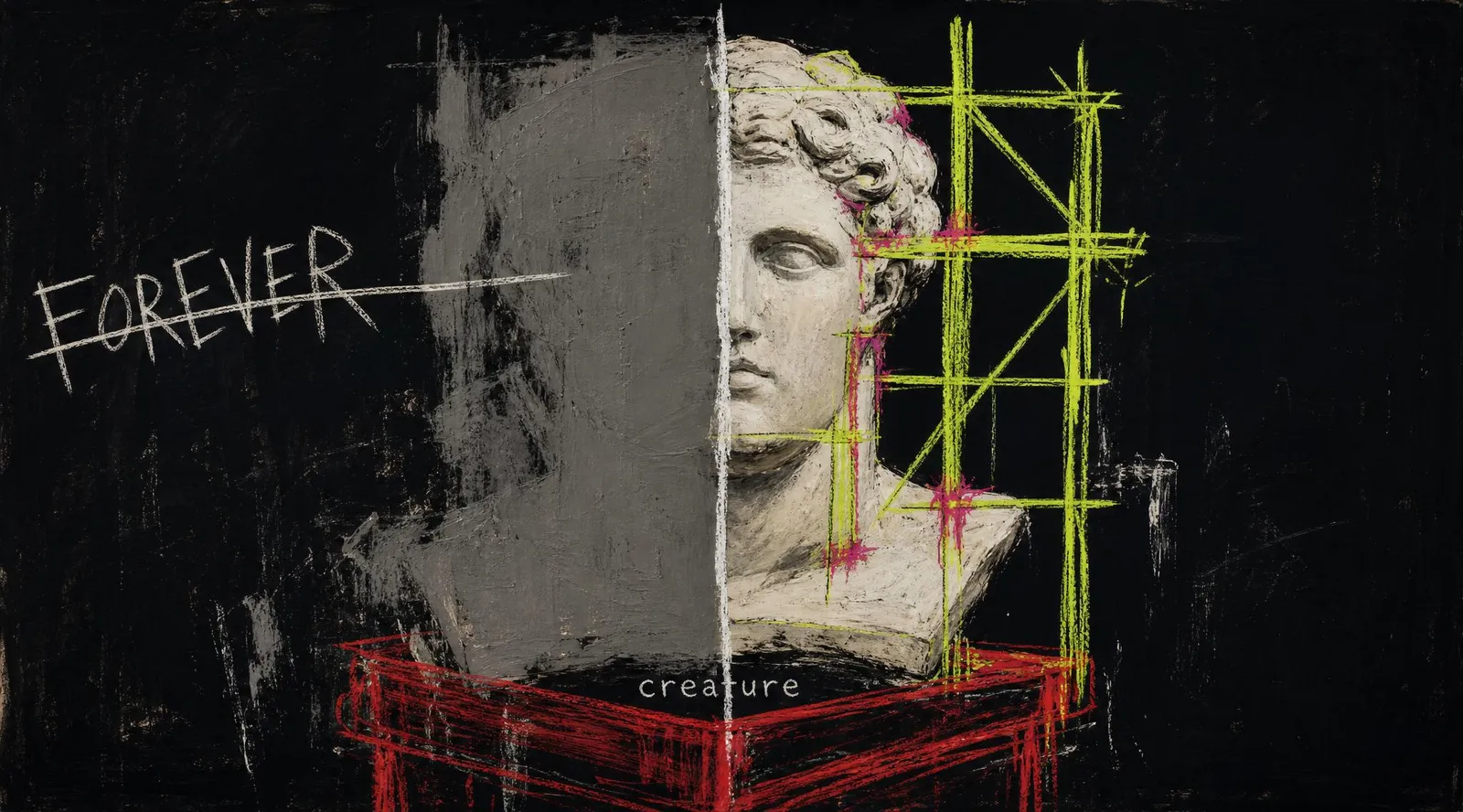
In December 1973, Sam Keen carried a tape recorder into a Vancouver hospital room. The man in the bed was Ernest Becker, 49, a cultural anthropologist dying of colon cancer and he understood exactly what the visit was. He had spent his career arguing that human character is a defence built against the knowledge of death and now the knowledge had arrived in his own body and the defence was coming down. “You can see how a philosopher dies,” he told Keen near the start. The conversation ran most of a day. Psychology Today published it that April. By then Becker was dead and two months after his death The Denial of Death won the Pulitzer Prize for General Nonfiction. He never knew about the prize. The timing reads like something he would have put in the book: the culture rewarding a man for describing its favourite defence, once he was safely unable to collect.
Retellings soften the book. At full strength the claim is this. Becker did not say that people are afraid of dying and distract themselves. He said the fear is unliveable at full intensity and that the psyche solves this in childhood by building a character that filters it out. Personality, on this account, is not a thing that has defences. Personality is the defence. He called it the vital lie: the organised set of blinkers a person assembles in order to function at all, then mistakes for who they are.
He built much of this out of Otto Rank, the analyst Freud had pushed to the margins, and he built it against Freud himself. Where Freud put repressed sexuality at the base of the psyche, Becker and Rank put repressed death. The child discovers early that it is a creature. It eats, leaks, breaks and will stop. Around the same time it discovers an inner life that feels boundless, symbolic, made for meaning. Becker’s word for the collision was creatureliness and his description of the condition was blunter than his readers usually remember: a god’s imagination housed in an animal that dies. Nothing about that arrangement can be faced head-on for long. So it is not faced head-on. It is buried under a self.
The burial continues outward. A single mortal cannot outlast death, so people attach themselves to things that might: children, firms, movements, books, buildings with a name over the door. Becker called these immortality projects and he called culture a shared hero-system, a standing agreement about which projects count, so that each member can feel like a contributor to something that does not stop when they do. Read one way, this is an anthropology of meaning. Read the way Becker meant it, it is harsher. Your ambition is not sitting beside your mortality, unrelated to it. It is the shape your mortality pressed you into. The unnerving part of the book was never the suggestion that you avoid the subject. It is the claim that the you doing the avoiding was built for the job.
For a decade the book sat where syntheses of psychoanalysis and theology usually sit: admired and untested. Then in the mid-1980s three social psychologists, Jeff Greenberg, Sheldon Solomon and Tom Pyszczynski, decided Becker had made an empirical claim whether he intended one or not. If self-esteem and worldview are armour against death, then reminding people of death should make them grip both harder. They called the idea terror management theory and in 1989 the founding paper made it famous. Twenty-two municipal court judges were asked to set bond for an alleged prostitute. Half were first asked to write briefly about their own death. The judges who had written about dying set bond at $455 on average. The others set $50. One paragraph about a corpse, and the law came down nine times harder on a woman accused of selling sex.
Hundreds of studies followed. Death reminders appeared to intensify patriotism, harden religious commitment, sour people on outsiders and inflate the appeal of anyone who praised the reader’s way of life. By 2010 a meta-analysis could pool 277 experiments and report a moderate average effect, strongest, tellingly, in American college samples, the population most fluent in the hero-system being measured. The textbooks wrote it up as a rare event: a dying anthropologist’s speculation dragged into the lab and vindicated. For a while, “science proved we are all in denial about death” was one of psychology’s better stories.
The story came apart the way many stories from that era did. In the largest test, the Many Labs 4 project, 21 laboratories ran the classic mortality salience procedure on 2,220 participants, with half the labs following a protocol built under the original researchers’ own guidance. They found nothing. Not a smaller effect. No detectable effect, under any condition. Other failures arrived in the same years, including registered reports in which the Bayesian analyses actively favoured the null. The theory’s defenders answered with a reanalysis arguing that the Many Labs result was driven by labs that came in under the preregistered minimum sample size and that the properly powered, author-advised studies do show the effect. That dispute has not resolved. The most thorough audit to date, published in 2025, worked through more than 600 studies with every bias-correction tool available and found the tools disagreeing with one another, which is itself the finding. Probably a real effect somewhere underneath, wildly inconsistent from study to study. Half the advertised size at best, resting on decades of studies too small to detect what they claimed to detect.
One result, though, replicated without drama. A registered replication across 22 labs in 11 countries confirmed in 2025 that death thoughts are easy to prime. A few written words and mortality sits measurably closer to the surface of a stranger’s mind, within seconds. What kept failing was only the downstream claim, that those thoughts make people clutch the flag. The near part held. Death is not far away in anyone. What the mind does with that proximity is where the evidence goes murky.
So there are two available readings of the wreckage and both are too easy. The deflationary one says Becker wrote beautiful prose about a mechanism that is not there, and the lab eventually called the bluff. The loyalist one says the mechanism is real and delicate and rushed replications on distracted online samples were never going to catch it. The harder reading is the one Becker’s own book forces. His claim was never a twenty-minute claim. If character is the armour, it does not come off because an undergraduate spends four minutes writing about their corpse. The armour is what is writing the paragraph. An experiment of that shape can only measure ripples on the surface of a structure that never switches off, and Becker described the structure, not the ripples. Which sounds like a rescue until you notice what it costs. A claim positioned where no experiment can reach it is not vindicated when the experiments fail. It changes category. It goes back to being what it was in 1973: an interpretation of a whole life, testable only by one.
Honest psychology has to say the mortality salience effect is small and unstable, and possibly not there at all. Honest philosophy has to say the experiments were never where the argument lived. Both statements fit in one mouth. That is the uncomfortable position the field has actually earned.
Which leaves the hospital room, because Becker got there first. Keen noticed that the dying man kept mentioning God, which the books had not, and asked him about it. Becker refused the obvious reading. He was not getting religious because death was close, he said. What had changed was the loss of the character armour. Everything psychology knows about a person, he told Keen, character and culture and the whole construction, amounts to a denial of creatureliness, and dying was the first time he could stop paying for the construction. Whatever he found underneath it, he had about three months to look at.
The floor of all this is firmer than the fighting suggests. Reminders of death reach you, measurably, in seconds and your mind keeps the subject nearer than it feels. Whether those reminders bend your politics by half a standard deviation is contested and may stay contested. The ceiling is where Becker left it. The book’s question was never whether you have an immortality project. Almost everything with your name attached qualifies. The question is what remains when the project stops holding, and the design flaw, the one Becker named and then lived, is that you find out at the one moment it can no longer help you. He found out in a bed in Vancouver with a tape recorder running. The recording still exists. You can hear a man checking his theory against the only data that counts.
Related: the self built by exclusion, approached from the other direction: Shadow Work Is Not What You Think It Is.
Sources
If this is the kind of thinking that doesn't leave when the tab closes.
Subscribe