The Self You Never Built
The most stable people you know might be the ones who never examined what they're stable about. The certainty is real. It was also never tested.
The most stable people you know might be the ones who never examined what they're stable about. The certainty is real. It was also never tested.
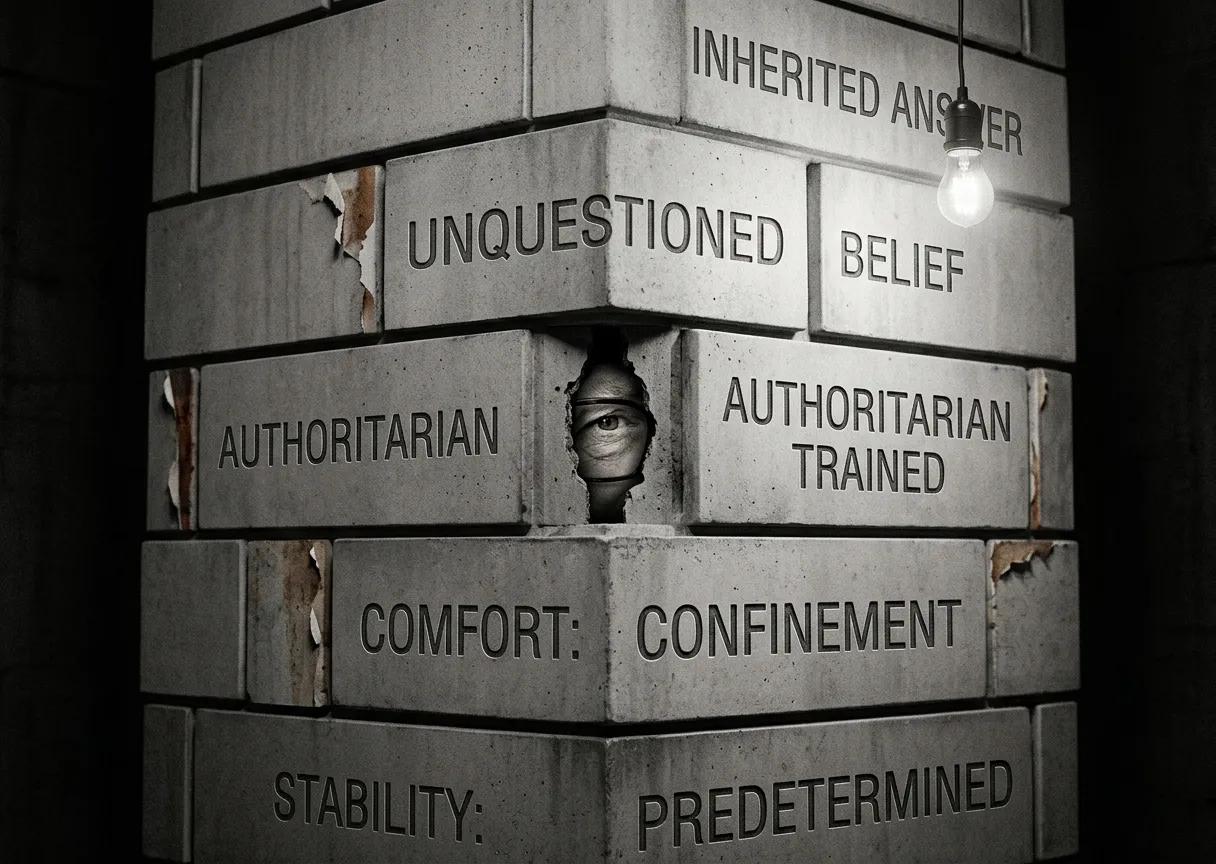
You can spot them by how fast they answer. Ask them what they believe and there’s no pause, no flicker behind the eyes where the thinking would be if thinking were happening. The answer comes pre-loaded. It was always there. It was there before the question, before the decade that should have complicated it. They know who they are the way a building knows where its walls are. Structurally. Without consultation.
And the thing you’re not supposed to notice is how little of it they built.
Marcia called it foreclosure, and the clinical sound of the word hides the thing it actually describes, which is a life committed to answers that were never questioned. Not chosen after comparison. Never examined at all. The beliefs came from somewhere, parents or a community that rewarded certain shapes and punished others, and the person wearing them accepted the fit without checking whether the clothes were theirs. And then twenty years passed. And the clothes are now the body.
This is different from not knowing who you are. The diffused person, the one still drifting, at least has the advantage of an open question. A question can be answered. Foreclosure is a closed answer, and the closure happened so early and so completely that the person inside it doesn’t experience it as closure. They experience it as identity. They experience it as self. The walls of the room they’ve never left feel like the edges of the world.
The research finds what you’d expect if you think about it and what nobody expects if they don’t: foreclosed people score lowest on openness to experience and highest on authoritarian thinking. They carry the most certainty and the least flexibility. Their self-esteem is high and their anxiety is low, and both of those numbers describe something real that is also something untested. You can’t be anxious about a question you’ve never encountered. You can’t doubt a position you adopted before you had the cognitive equipment to evaluate it. The comfort is real. It is the comfort of a room with no windows, and calling it comfort doesn’t make it less of a room.
What gives this its weight, the thing that turns it from a psychological category into something that lands in the body, is how invisible it is from the outside. The foreclosed person looks identical to the person who went through the fire and came out the other side. Same confidence. Same ability to make decisions.
The difference between inherited certainty and earned certainty is invisible at dinner. It’s invisible in a marriage, often for years, partly because human architecture is rarely a single monolith. We are patchworks. A person might forge a fiercely authentic career in the crucible of real risk, yet live inside a hand-me-down marriage or an inherited political worldview. The foreclosed self can coexist with the tested one, hiding in the rooms we decided early on never to renovate. The structure holds, and holding is what structures do, and nobody asks whether the thing holding is load-bearing or decorative until the load arrives.
We like to tell ourselves that the load always arrives. It makes for better stories. We want the narrative to demand a reckoning.
But the most terrifying truth of the unexamined life is that sometimes, the load never comes. Some buildings never face a hurricane. People can go decades, an entire lifespan, held up by walls of pure inheritance. The structure holds not because it is strong, but because the weather was kind, or because they built a life so rigid that nothing unpredictable was ever allowed inside. No midlife crash. No sudden disruption. Just a slow, steady march through the epilogue.
But when the load does arrive, and the framework can’t accommodate it, it is absolute. A parent dies and the grief doesn’t fit. A child turns out to be someone the framework can’t hold. The career reveals itself to have meant nothing beyond its own continuation. The person whose identity was built through exploration has been here before. They know what it’s like for the ground to move. They’ve practised falling and getting back up. The foreclosed person is experiencing freefall for the first time at forty-seven, with no muscle memory for uncertainty and a self that was never designed to flex. What breaks in these moments is not a single belief. What breaks is the entire load-bearing wall of a personality that was assembled in adolescence from available materials.
The midlife crisis gets treated as a joke. The sports car. The sudden interest in ayahuasca or leaving everything behind. But strip the comedy away and what you’re looking at is someone whose inherited self has met the first question it can’t absorb. They are discovering that the confidence they’ve been running on for decades wasn’t confidence at all. It was the absence of a test. And the test has arrived, and they skipped the preparation because their environment rewarded the skipping, and now the bill is for everything.
Bohlmeijer gave this a name that does more work than most academic language manages: narrative foreclosure. The conviction that no new interpretation of your past and no new experience in your future can change your story in any way that matters. You know how the book ends. You’ve stopped writing new chapters. You’ve stopped rereading the old ones. The story is finished and you are living in its epilogue, and the epilogue has no arc and no tension and no possibility of surprise. The absence of surprise feels like peace until you realise that what you’re calling peace is the same thing a closed system calls equilibrium. Nothing is moving.
The cruelest part is that foreclosure is rarely chosen. It’s produced. Families that treat doubt as disloyalty. Professional tracks that select for early commitment and reward people who can hold a shape without wavering. Blaming someone for their foreclosure is blaming them for surviving the only way they were offered.
But understanding this doesn’t dissolve what it costs. The cost is a life lived inside a self that was never interrogated, and a self that was never interrogated is a self that carries its owner slightly to the left of wherever their own gravity would have placed them. It shows up not as suffering but as a flatness, a way of being present that is also a way of being absent, a relationship to experience that has the quality of a script being followed rather than a life being lived.
Kroger’s meta-analysis found that most people never reach identity achievement. The difficult, uncertain, self-dismantling work that developmental theory treats as the precondition for a real self is something most skip. And perhaps we shouldn’t romanticise the flames. The fire of exploration doesn’t always forge a tempered self; sometimes it just burns the house down. The person who wanders into the wilderness of who they are isn’t guaranteed to return. Some stay diffused forever, paralysed by the endlessness of open questions, burning through the years in chronic, agonising instability.
But those who skip the fire entirely find a shape and hold it. The shape works in the sense that it produces a functional life. What it doesn’t produce is a self that knows its own strength, and what a fireproof self means for the person living inside it is a question that doesn’t get asked until the flames show up uninvited.
Systems love a foreclosed person. Institutions run on them. A person who has stopped writing new chapters is a person who can be predicted. The structures that depend on this reliability, the partnerships, the entire social architecture of adult life, are built on the assumption that the person inside will continue to be the person they’ve always been. When the book opens again, the disruption radiates into the lives of everyone who was counting on the shape to hold.
And so most people keep the book closed. They feel the flatness and they call it maturity. They carry a patchwork self they only halfway examined and they call it strength. The calling-it-strength is the last and most durable act of foreclosure, because once you’ve decided that your unexamined life is a sign of stability, you’ve foreclosed on the possibility of recognising your own foreclosure. The room has no windows and you’ve decided the room is the world.
And maybe it is. Maybe the examined life isn’t always worth the wreckage. Maybe the people who never questioned what they were given are the lucky ones, spared the agony of chronic diffusion, spared the shock of discovering in middle age that the self you’ve been living in was a rental you mistook for ownership.
But there’s that flatness. That look behind the eyes where the thinking would be if thinking were happening. You’ve seen it. You know what it means. You might even know what it feels like from the inside, that faint persistent suspicion that the life you’re living fits perfectly, and belongs to someone else.
If this is the kind of thinking that doesn't leave when the tab closes.
Subscribe