Why your performed self might be more honest than your felt one
The interior has never been required to make sense to anyone. The performance has.
The interior has never been required to make sense to anyone. The performance has.
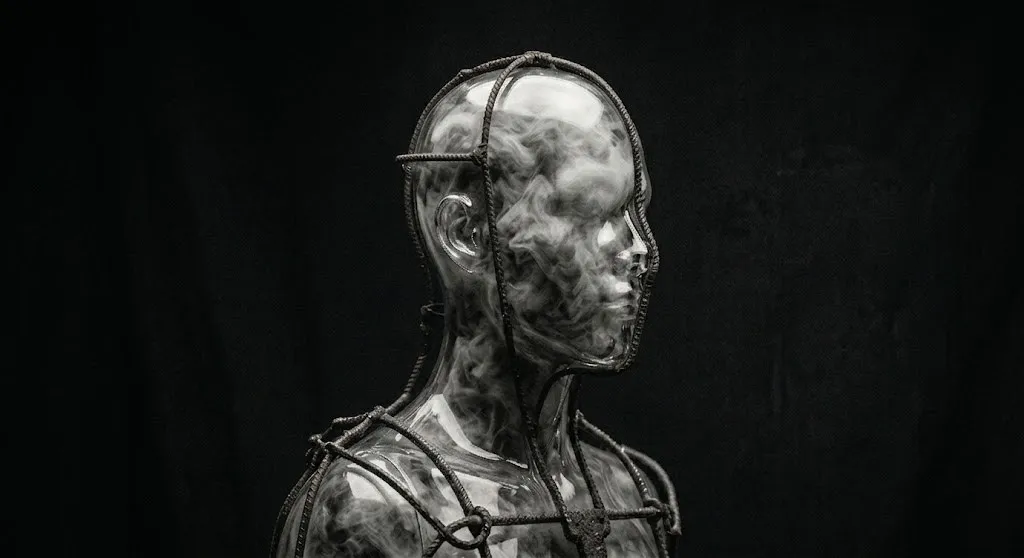
There is a standard story about the self that almost no one questions. The performed self is the lie, the felt self is the truth, and becoming a person means moving the second into public view at the expense of the first. The story has the epistemic order backwards. The performed self has been edited by consequence. The felt self has not. The performance has met the world enough times to have been corrected. The interior has not met anything. This should put the burden of proof on the felt self, not on the performed one. It does not, and the reason it does not is itself worth examining.
What the inner self consists of, when looked at honestly, is largely unmetabolised noise. Wants that have never been tested against anyone else’s wants. Reactive states the body produces in response to stimuli the conscious mind has not yet processed. Resentments that may or may not be tracking anything real. Intrusive thoughts that pass through without consent and leave traces. Aspirations that have never been pressure-tested against the cost of pursuing them. Fears that may be calibrated to the present or may be carryovers from a situation that no longer exists.
Not all of this is noise. The interior also produces signal: intuitions that are tracking something the surrounding social field will not yet acknowledge, moral revulsion that is reading a situation more accurately than the conscious mind can articulate, creative impulses that have not been domesticated by reception. The argument here is not that interiority is empty. It is that interiority is undifferentiated. The same buffer holds both the genuine signal and the unmetabolised noise, and the felt self has no internal mechanism for telling them apart, because the only mechanism that can tell them apart is contact with something other than itself.
The interior is a buffer where psychological material accumulates faster than it can be sorted. Calling this material “the real you” is not a description of its reliability. It is a description of its proximity. The interior is closer, so it feels truer. Proximity is not accuracy. Whatever the felt self is, it has not been required to make sense to anyone, including itself, and the absence of that requirement is what allows it to remain as raw and as unprocessed as it does.
The performed self has the opposite epistemic situation. Every gesture it has made has been received by other people, who responded in ways that taught the performance what to keep and what to drop. The inflections that landed got reinforced. The ones that produced confusion or hostility got pruned. The performance one ends up running, by the time one is in one’s thirties or forties, is the result of decades of feedback, much of it harsh, almost all of it more honest than anything the interior has had to encounter.
Goffman is sometimes read as if his account of impression management were a scandal, as if the discovery that we perform ourselves were itself the lie being exposed. The closer reading is that performance is the only place where the self enters the field of accountability. The interior is private and therefore uncorrected. The performance is public and therefore corrected. Which of these has more claim to honesty depends on what one means by honesty.
The standard definition treats honesty as the absence of mediation. To be honest is to express what is felt without social filtering. The reverse definition treats honesty as the presence of correction. To be honest is to make claims that have been tested against something other than oneself. The first definition makes interiority sacred. The second makes performance the only honest mode. The standard definition is the one that has won, but it should not have, and Han’s analysis of why it did is the apparatus that opens up what is actually going on.
Han’s argument about authenticity is that the cultural imperative to be authentic produces the very interior it then asks people to express. The demand for authenticity is not a discovery of an inner reality that was always there. It is a manufacturing process. People are required, more or less constantly, to introspect, to identify their feelings, to articulate their values, to express their truths, and the requirement creates the inventory it then asks them to display. What gets called the inner self is, on this reading, largely a cultural product, generated by the demand to have one. This is why so much of what people produce when asked to express their authentic selves sounds suspiciously alike. It is the same product, manufactured by the same apparatus, branded with different surface differences. The standard story tells you to trust this product because it came from inside. Han points out that inside has been colonised by the producer.
This is also where the performance of authenticity becomes its own paradox. Authenticity, by definition, can’t be performed; the moment it is, it has stopped being what it claims to be. But the cultural pressure to perform it doesn’t go away because of the contradiction. It gets stronger.
The Winnicott version of the standard story is the one most people inherit. The true self is spontaneous and alive. The false self is compliant and defensive. Recover the first, dismantle the second, and that’s it. This reading misses the structural point. For Winnicott, the false self is a developmental achievement, often a heroic one, that protects the conditions under which a true self might survive. The mistake is treating it as a tumour to be removed. Winnicott treats it as scaffolding. Removing the scaffolding before there is anything underneath capable of standing on its own is not liberation. It is collapse. Some people have a true self ready to emerge when the false self is dismantled. Many do not, because the conditions for building one were never met, and what is underneath the false self is not a buried treasure but an absence the false self was protecting them from having to face.
This is the part of the argument that runs hardest against the grain. It is also the part that is closest to what most people quietly suspect about themselves when they are honest. The interior, examined directly, is often less coherent than the performance. The performance has been required to make sense in front of other people. The interior has been allowed to remain a mess because no one was watching. When people say they feel like they are pretending to be themselves, the standard reading is that they are pretending and there is a real self being suppressed. The closer reading is that the performed self has been built over decades and the felt self has not, and the felt self’s failure to feel real is partly accurate. It is less real, in the sense of less constructed, less tested, less continuous.
What follows is uncomfortable. If the performed self is more reliable than the felt self, then becoming a person is not done by expressing what is inside. It is done by building things outside that one then has to live up to. Commitments. Relationships. Public positions. Forms one cannot retreat from without consequence. These are what generate the corrected self.
This argument depends on an assumption that has to be named. It assumes the social field doing the correcting is functional enough to do real correcting, rather than producing coerced compliance. Where the field is sane, performance gets edited toward something closer to accuracy. Where the field is captured by abuse, ideology, or coercion, performance gets edited toward survival, and the interior’s discomfort is then Sartre’s bad faith in reverse: not the interior pretending to be free when it isn’t, but the interior registering accurately that the performance has been forced. The toxic case is real and the argument does not absorb it. It belongs to a different essay. What the present argument addresses is the standard case, where the social field has at least the capacity to push back, and the felt self’s claim to truth runs into the fact that the performance has been pushed back against and the interior has not.
The interior, on its own, will keep producing material indefinitely without any of it ever becoming a self. The self gets made by exposure, by contact, by the long pressure of having made claims one then has to inhabit. Introspection on its own does not build a self because introspection has nothing to push against except more of itself.
The romantic version would say that the soul is forged in the world. A colder version names the same fact differently: the interior produces material, the performance produces structure. Without the structure, there is nothing the material can sediment around. None of this means the felt self is worthless. It means the felt self is raw material rather than finished product. Treating it as finished product is the mistake the standard story makes. The cost of the mistake is that people spend decades trying to express something that has not yet been built, neglecting the only process that could have built it, which is exposure.
The performed self is more honest because it has been corrected. The felt self is less honest because it has not. Cultural insistence that interiority is enough has produced a generation of people fluently articulating selves they have not actually built, and wondering what an identity crisis is actually telling them. The articulation does not feel real because it is not. Interiority was never going to be enough on its own. The suspicion that something is wrong is the most accurate part of the experience.
If this is the kind of thinking that doesn't leave when the tab closes.
Subscribe