The self you kept while you were agreeing
Fromm said conformity is the loss of the self. Asch's data says the opposite. Most people never lose it. They keep the private judgment and agree anyway.
Fromm said conformity is the loss of the self. Asch's data says the opposite. Most people never lose it. They keep the private judgment and agree anyway.
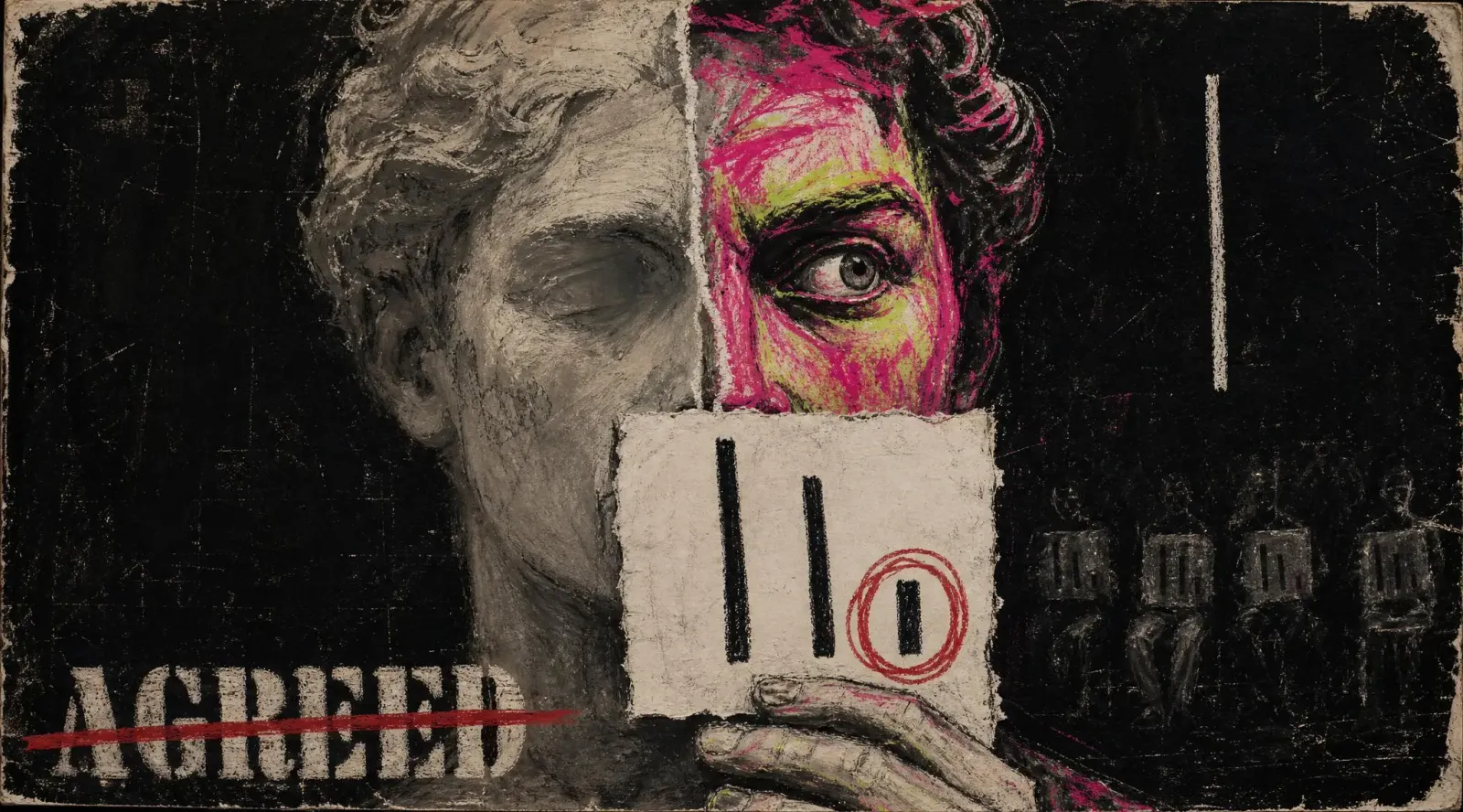
At Swarthmore in the early 1950s, Solomon Asch sat a young man at a table with seven other people and showed the group a card with a line on it, then a second card with three lines, and asked which of the three matched the first. The answer was not hard. In the control condition, with nobody else in the room, fewer than one per cent of answers were wrong. But the seven others at the table were not other subjects. They had been told beforehand to give, on twelve of the eighteen rounds, the same wrong answer, out loud, without hesitation, one after another, so that by the time it came round to the real subject he had already heard six confident people call a shorter line the match. He looked at the lines. He could see. And on a good number of those rounds, he said the shorter line too.
Across Asch’s programme, about a third of answers on the loaded rounds went to the majority, and roughly three quarters of subjects caved at least once. That is the number that made him famous, and it gets quoted as if it settles something about people. Put a person in a room where everyone agrees on something false, and the person folds.
Erich Fromm had written the verdict a decade before Asch ran the experiment. In 1941, in the chapter of Escape from Freedom where he lays out the ways people flee the burden of being separate, he describes automaton conformity. The individual ceases to be himself. He takes on the personality handed to him by the culture and becomes exactly like everyone else and exactly what they expect. The gap between the self and the world closes, and with it the fear of standing alone. Fromm says the price is high. It is the loss of the self.
It is a description that has never stopped sounding true, which is why it keeps circulating, cut down to the part that stings. And it circulates because people read it and feel caught. They recognise the automaton. What is worth sitting with is that Asch’s data does not say what Fromm’s sentence says, and the difference is where the real trouble lives.
Asch did not find that people cease to be themselves. He found something stranger. He found that people stay themselves and agree with the group anyway.
This is not a revisionist reading. It is Asch’s own. In 1990, Ronald Friend, Yvonne Rafferty and Dana Bramel went through ninety-nine social psychology textbooks published between 1953 and 1984 and tracked how the study had been reported. What they found was a drift. Over three decades, authors steadily inflated the conformity finding and shrank the independence finding, until the study that Asch had titled Studies of Independence and Conformity was being taught as the conformity study, full stop. Asch, they argued, intended it at least as much as a demonstration of how much independence survives group pressure.
The numbers back this. A quarter of his subjects never conformed once, across all twelve loaded rounds. Only five per cent conformed on every one. The modal subject was independent on most trials. And the ones who did cave mostly did not lose their grip on the lines. Asch sorted the yielders into three kinds after interviewing them: a few had actually seen the lines the way the majority called them, some had come to doubt their own judgement, and the largest group had done neither. They saw the correct line, knew it was correct, and said the wrong one anyway. Asch called that last category distortion of action. Not perception. Not judgement. Action.
Later variations sharpened it. When the subject wrote the answer privately instead of saying it aloud, conformity dropped to around twelve per cent. When even one other person in the room broke with the majority, it collapsed to near nothing. Deutsch and Gerard named the mechanism in 1955: normative influence, which buys public agreement without touching private belief, as against informational influence, which changes what you actually think. The line task was built so the answer was obvious, which meant there was almost nothing informational about it. What Asch caught was people managing an audience.
The self was never absent. It was doing a calculation about which cost was worth paying, and paying it.
Then there is the part that should make anyone cautious about reading either Fromm or Asch as a law of human nature. In 1996, Rod Bond and Peter Smith pulled together every Asch-style line study they could find, a hundred and thirty-three of them, across seventeen countries. Two things came out. Conformity in American studies had been falling steadily since the 1950s, so the famous figure was a snapshot of a decade and not a constant. And conformity tracked how collectivist the country was, with collectivist countries running higher than individualist ones. Some replications, including Perrin and Spencer’s in Britain, found almost no conformity at all.
So the automaton is not a fixed feature of the human being. It is a reading on a gauge, and the gauge moves depending on when you were born and what kind of society taught you what agreement is for. In a culture that treats yielding to the group as a form of respect rather than a defeat, the same behaviour means something different from the inside. Fromm was writing in 1941, watching whole nations organise themselves around a leader, and the automaton he described was real and was doing terrible things. But he wrote it as a permanent psychology, a thing that happens to man, and the data underneath it turns out to be a thing that happens to some people, in some rooms, at a strength you can turn up or down, and to a quarter of them not at all.
Here is where it stops being a story about an experiment. The uncomfortable finding is not that people fold. Everyone already suspected that. The uncomfortable finding is the distortion of action. The seeing-clearly-and-agreeing-anyway. Because the automaton, if it worked the way Fromm described, would at least be at peace. It would have paid for its belonging with the whole self and would not have to feel the transaction. There would be no I left to notice the gap between what it said and what it saw.
The person who keeps the private judgement does not get that peace. They belong, and they know the price, and they carry the knowing around. Every time they say the shorter line is the match, some part of them files it, and the file grows. This is the mechanism Fromm half saw and named wrong. He thought the danger was disappearing into the crowd. What the transcripts show is not disappearing at all. It is staying entirely yourself while your voice says otherwise, day after day, in ordinary rooms where the pressure is milder than Asch’s and the stakes feel too low to be worth the alone. Nobody folds on the big things first. They fold on the line length. The line length that does not matter, so why make it strange.
Jung had a word for the face assembled to meet the group’s expectation, the persona, and he was careful that the persona is not a fault. Nobody can meet the world with the raw whole of themselves. The problem he pointed at was not having one but mistaking it for the self, letting the mask thicken until you could not tell from the inside where the performance ended. What Asch caught is the moment before that mistake, when the seam is still visible, when the person can still feel the difference between the line they see and the line they name. The mask has not fused. It is being held up by hand, at a cost the person can still feel.
The question Fromm’s sentence forecloses, and the data reopens, is what happens to someone who holds it up by hand for long enough. Whether the file stays legible. Whether the quarter who never conformed were made of something else, or had simply not yet been in the room where the price of standing alone was set high enough to move them. Asch could raise conformity by changing the room. He never found the room that got everyone. He also never found the person the room could not touch. Both of those absences are still sitting in the data, and nobody has closed them since.
Sources
Asch, S. E. (1956). Studies of independence and conformity: I. A minority of one against a unanimous majority. Psychological Monographs: General and Applied, 70(9), 1–70.
Bond, R., & Smith, P. B. (1996). Culture and conformity: A meta-analysis of studies using Asch’s (1952b, 1956) line judgment task. Psychological Bulletin, 119(1), 111–137. doi:10.1037/0033-2909.119.1.111
Deutsch, M., & Gerard, H. B. (1955). A study of normative and informational social influences upon individual judgment. Journal of Abnormal and Social Psychology, 51(3), 629–636.
Friend, R., Rafferty, Y., & Bramel, D. (1990). A puzzling misinterpretation of the Asch ‘conformity’ study. European Journal of Social Psychology, 20(1), 29–44. doi:10.1002/ejsp.2420200104
Fromm, E. (1941). Escape from Freedom. New York: Farrar & Rinehart. Published in the UK as The Fear of Freedom. Automaton conformity is set out in the chapter on mechanisms of escape.
Perrin, S., & Spencer, C. (1981). Independence or conformity in the Asch experiment as a reflection of cultural and situational factors. British Journal of Social Psychology, 20(3), 205–209. doi:10.1111/j.2044-8309.1981.tb00533.x
Related
Shadow Work Is Not What You Think It Is - on the shadow as exile rather than darkness. That essay is about what got cut away to make you acceptable. This one is about the cutting being felt while it happens.
Why You Feel Like a Different Person Around Different People
If this is the kind of thinking that doesn't leave when the tab closes.
Subscribe