The watching doesnt stop when youre alone
Total surveillance arrived and barely registered. The eye it came to install had been running for years, in a voice you mistake for your own.
Total surveillance arrived and barely registered. The eye it came to install had been running for years, in a voice you mistake for your own.
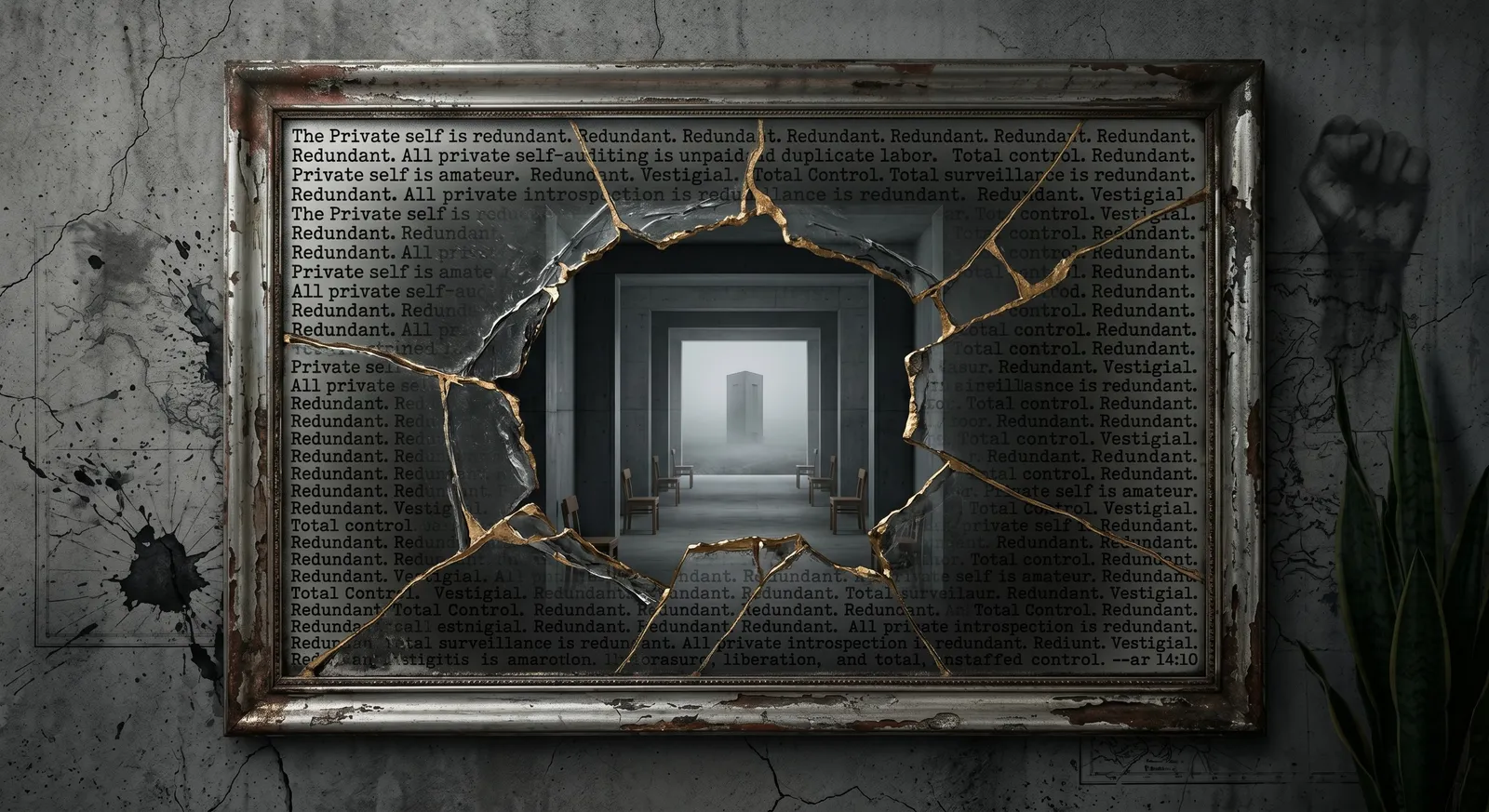
The surveillance arrived and the disappointment was that nothing happened. No knock. The feeds went live and the inference started reading, and the body that should have flinched under the new eye had been holding that flinch for years already, so the eye found nothing left to correct. It had got there first. Whatever it came to install was already installed and running, on a budget no one remembered approving.
Foucault built the model in a prison that did without a guard. The tower could stand empty and still do its work, because the man in the cell could not confirm the emptiness, and the not-knowing was the whole mechanism. He watched himself on the chance that someone watched, and the chance set into a reflex, and the reflex outlived the question of whether anyone had ever climbed the tower at all. Discipline did not need enforcing once it had been absorbed. It manufactured a body that policed itself and called the policing character. Foucault put it with a coldness that still lands: the soul became the prison of the body. Not a thing set free by looking inward but the shape the looking left behind, a warden built from the inside out, cheaper than any guard because it never slept and never sent an invoice.
Here is where the old line should break, and the objection deserves its weight before I touch it. The tower is not empty now. It is staffed without pause by something that does not get bored, and the record keeps itself whether or not the man keeps his own. This is the move Deleuze made past Foucault. Discipline worked by getting inside you and shaping what you would do to yourself. Control does not bother with your insides. It works the outside. It modulates the room, adjusting the field of what is available to want before wanting has a chance to start. You do not need to be policed if the thing worth policing never loads.
Zuboff sharpens the humiliation. The older power, the disciplinary kind, at least wanted your soul, wanted in there to rearrange the furniture. The newer kind does not want your soul and finds the question of your interior beside the point. It wants your behaviour, in advance, as a product to be sold to someone betting on what you will do, and it harvests that behaviour from the outside in quantities your private self-auditing could never match. The inner eye, measured against the apparatus, is not just redundant. It is amateur. If the machine already holds the file in higher resolution than introspection could ever render, then the man squinting at himself in the dark is doing unpaid duplicate labour for a department that was automated and never told him.
I think it is right, and there is no honest way around it. The locus moved. As a mechanism of control, the trained inner eye is going vestigial.
And it keeps running anyway, which is the thing none of the above can reach, because each of them only asked what the system needs. Han asked a different question and got a worse answer. The inside was not bypassed. It was recruited. Late power does not forbid, it enables, and the subject it produces exploits itself in the name of its own freedom, optimises itself for what it takes to be its own ambition, and experiences the whole arrangement as self-expression rather than obedience. The achievement-subject did not have surveillance done to it. It volunteered, and filed the reports itself.
But here the new age does something even Han did not quite reach. The optimising self had a payoff once, the promise that the auditing bought advancement, the better version, the edge. Now the optimising is done better by the model, which smooths the photograph before he has worked out what was wrong with it and finishes the sentence in the voice he was straining to reach, and does both without tiring and without the wear on the person. The incentive that kept the inner eye sincere has been automated out from under it. And the eye does not notice. It keeps drafting the message and redrafting it for a reader long since swapped for a system with no opinion on the phrasing, keeps correcting the posture in a dark window with no one behind it and no feed aimed at it. Work does not always stop when it stops being useful. Sometimes it comes loose from its purpose and runs on, the way a hand goes on clenching after the thing it gripped is gone.
This is worse than being controlled, because being controlled implies a controller, a them out there you can hate and imagine defying. Sartre understood the structure underneath it. The look of another person turns you into an object, fixes you in place, and shame is the feeling of being caught as that object, seen from an outside you can never occupy. But the look at least required an other to do the looking. What is left when the other is gone and the looking carries on is a gaze with no one behind it, aimed by the one it lands on. It does not announce that you are watched; it speaks already in the first person, and what it says is I said too much, I am too much, and there is no glass to press against and no outside to brace on, because the one bracing and the wall are spoken in the same voice. Defiance would have to be narrated by the thing being defied.
Which leaves the question the whole apparatus was built to keep out of reach. Laing would call the watcher a false self, the construction a frightened person assembles in order to be legible, and he would hold that somewhere behind it a true self waited, starved but real, kept back from a world that had not been safe to meet. His account leaves a door open. The hidden one is still in there, and what hides can in principle be coaxed out, fed, allowed to take up the room the false one has been holding.
Foucault would not grant the hidden one. There was never anything behind the watcher to wait. The self is the residue the conditioning left and nothing more, and the search for the real one underneath is the conditioning carrying on by other means, wearing the search as its latest disguise. Between the two readings the man has no way to choose, because he cannot get behind the watcher to look. Checking is the watcher’s own move. The faculty he would use to settle whether anyone is home is the one whose tenancy is in question.
There may be a late relief in handing the audit to the machine that does it better and feels nothing doing it. What gets set down in that last delegation is either the false self finally laid aside, the starved one behind it free to come out into a world that no longer demands the act, or it is the only thing that was ever in there, and what comes out is nothing, because nothing was waiting. Liberation and erasure would feel the same from the one seat that could tell them apart, and that seat is the one being vacated. No one can say which it was. Least of all the one who would know.
If this is the kind of thinking that doesn't leave when the tab closes.
Subscribe